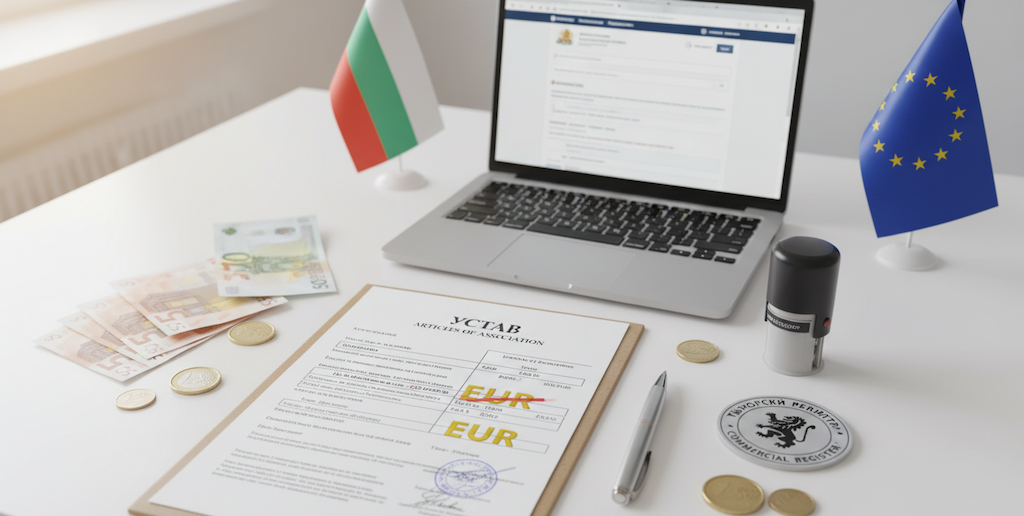
Bulgaria officially adopted the euro on January 1, 2026, becoming the 21st member of the eurozone. While the Commercial Register automatically converted all registered company capital from BGN to EUR at the fixed rate of 1 EUR = 1.95583 BGN, the paperwork is far from done.
If you own or manage a company in Bulgaria and haven’t started this process yet, here’s everything you need to know.
What happened on January 1, 2026?
On Euro Day, the Commercial Register automatically recalculated every company’s registered capital from leva to euros. Shareholders’ ownership stakes remained exactly the same, and no action was needed from businesses for the conversion itself.
However, your company’s internal governing documents — the Articles of Association for OODs and EOODs, or the Statutes for joint-stock companies (ADs and EADs) — still contain the old BGN figures. These documents must now be formally updated to match the euro amounts reflected in the Register.
The legal basis
The obligation comes from Article 32 of the Act on the Introduction of the Euro in the Republic of Bulgaria (AIERB), originally adopted in August 2024 and subsequently amended in July 2025. The law gives all commercial companies a 12-month window from the euro adoption date to bring their corporate documentation into compliance.
Who is affected?
This requirement applies to all companies registered in the Bulgarian Commercial Register, including:
- OODs (limited liability companies with multiple shareholders)
- EOODs (single-shareholder limited liability companies)
- ADs (joint-stock companies)
- EADs (single-shareholder joint-stock companies)
- KDAs (partnerships limited by shares)
- VCCs (venture capital companies — with slightly different rules for internal documentation)
In short — if your company is in the Commercial Register, this applies to you.
What exactly needs to be done?
The process involves several steps:
- Prepare updated Articles of Association (or Statutes) with all capital and share values expressed in euros, using the fixed conversion rate and rounding to two decimal places.
- Draft a shareholder resolution approving the amendments. For OODs, capital-related changes typically require unanimous shareholder consent — either through a meeting or a written consent procedure.
- Notarize documents if required. Whether notarization is necessary depends on what your current Articles of Association stipulate. If they allow simple written form for capital-related decisions, you may skip this step.
- File the updated documents with the Commercial Register, either electronically (requires a qualified electronic signature) or on paper.
The deadline: December 31, 2026 — but it could come much sooner
All updated documents must be submitted to the Commercial Register by the end of 2026. While this may seem far off, there is a critical rule many companies overlook.
Under the law, the updated Articles of Association must be filed either when submitting the first application for registration of any corporate matter made in 2026, or by means of a separate standalone application before December 31, 2026. In practice, this means that if your company needs to file anything at all with the Commercial Register in 2026 — adding or removing a shareholder, appointing new management, changing the company name, updating your business activities, or any other corporate change — you will be required to include the euro-updated Articles of Association with that filing.
This is an important detail. It means that your effective deadline is not necessarily December 31, 2026, but rather the date of your next Commercial Register submission — whichever comes first. Companies that plan to make any corporate changes this year should prepare their euro documentation well in advance to avoid delays in those filings.
What does it cost?
The good news: the Bulgarian government has waived state fees specifically for euro conversion filings. However, notary or solicitor costs may still apply depending on your company structure.
What happens if you miss the deadline?
Non-compliance is not an option you want to explore. Missing the December 31, 2026 deadline could result in:
- Administrative fines and penalties
- Blocked ability to register future changes — meaning you won’t be able to update shareholders, management, activities, or any other corporate details until the euro update is completed
- Administrative sanctions that could disrupt your business operations
The law is clear: this is a mandatory obligation, not an optional update.
A quick note on rounding differences
When capital is converted from BGN to EUR, minor rounding differences may occur. The law allows limited liability companies to make capital adjustments of up to 5% through a simplified procedure, without going through the full capital modification process under the Commercial Act. Differences beyond 5% require formal capital modification procedures.
These rounding adjustments should be recorded as retained earnings or losses in your accounting records.
Let me handle the paperwork for you
I can take care of the entire process for you — from preparing the updated documents to filing them with the Commercial Register. Get in touch to discuss your company’s euro documentation update. Let’s get it done right.